
Heroes Don’t Create Organizational Risk.
- May 30
- 5 min read
They reveal it.
Designing For Scalt: Growth Without Guesswork Series
Build the Roadmap & Prioritize · Article 7 · By Colleen Liebson
June 1, 2026

Every organization has one. The person everyone calls when something goes wrong. The one who knows where the information is. The one who can navigate the exceptions. The one who can somehow pull off the impossible when a deadline is slipping. They’re often celebrated as indispensable.
But here’s the uncomfortable truth: The more indispensable someone becomes, the more likely they’re compensating for a system that isn’t working. Heroes don’t create organizational risk. They reveal it.
Picture this: a major deadline is slipping, the project is teetering on the edge, and chaos is building. Then Dwight from The Office TV series walks in—binder in hand, laser-focused, ready to do “whatever it takes.” He works late, bypasses the usual steps, pulls in a few loyal allies, and saves the day.
Everyone cheers. The crisis is averted. Leadership breathes a sigh of relief.
But beneath the applause, something else is happening: the organization is rewarding workarounds, not building capacity. And for leaders, that’s a flashing warning light.
Why Hero Culture Emerges
Hero culture is rarely intentional—it grows quietly as the company scales.
• In early stages, a handful of high performers “just make it happen.”
• Growth outpaces systems, and heroes fill the gaps.
• Heroes emerge where process doesn’t exist.
• Leaders—often unintentionally—start rewarding firefighting over prevention.
As organizational psychologist Adam Grant puts it, “What gets rewarded gets repeated.” When last-minute saves are celebrated more than durable solutions, organizations normalize crisis management and underinvest in systemic fixes.
Heroes Are Signals
When the same person repeatedly saves the day, leaders should get curious. Not because the hero is doing something wrong. Because the organization may be.
Heroes often emerge when:
• Ownership is unclear
• Processes aren’t documented
• Roles overlap • Systems don’t support the work
• Training is inconsistent
• Decisions get stuck
The hero becomes the workaround.
The workaround becomes the process.
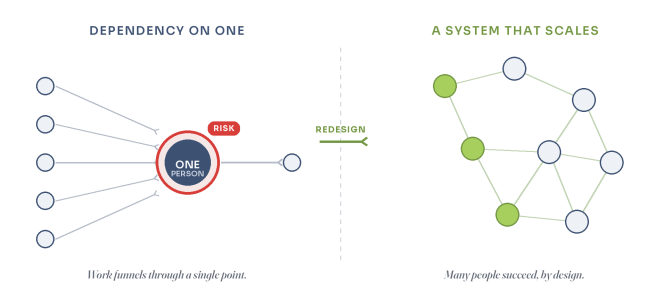
And eventually the organization depends on something that was never designed to scale.
While heroes often create short-term success, they can unintentionally create long-term challenges.
They become bottlenecks because critical decisions, knowledge, or approvals flow through a single person.
• Work slows when they’re unavailable.
• Projects wait for their input.
• Teams hesitate to move forward without them.
Quality can also become inconsistent. Because the hero is often working around the system, success depends on individual expertise rather than a repeatable process. The outcome becomes tied to who is involved rather than how the work is designed.
Hero cultures can also limit the development of the broader team. When one person is consistently viewed as the answer, others have fewer opportunities to learn, solve problems, and build confidence. Over time, capability becomes concentrated rather than distributed.
The impact on morale is often subtle but significant. Team members may begin to feel their contributions are less valued, that advancement opportunities are limited, or that leadership only recognizes a select few. Others may stop taking initiative because they assume the hero will ultimately step in and handle the problem.
What begins as a strength can quietly become a constraint.
The strongest organizations don’t build dependency on a handful of exceptional individuals.
They build systems, processes, and teams that allow many people to succeed.
What Highly Effective Leaders Do Instead
Highly effective leaders don’t celebrate every rescue.
They study it. Every last-minute save creates an opportunity to ask:
• What failed?
• Why was intervention required?
• What signal did we miss?
• What would have happened if the hero wasn’t available?
• How do we prevent this from happening again? The goal isn’t to eliminate high performers.
The goal is to make extraordinary effort unnecessary.
When organizations continuously examine recurring heroics, they begin to uncover patterns:
• Decisions that consistently get stuck
• Handoffs that repeatedly break down
• Processes that rely on tribal knowledge
• Teams that lack clear ownership
• Workflows that no longer support the business as it grows
Each rescue becomes feedback. Each bottleneck becomes an improvement opportunity. The strongest organizations don’t simply solve today’s problem. They strengthen the system so the same problem doesn’t return tomorrow.
The Leader’s Role: Build Systems That Scale
Heroics often mask the very problems leaders need to see.
That’s why effective leaders create visibility into operational friction instead of allowing workarounds to hide it.
They:
• Define clear ownership and accountability
• Document and standardize critical processes
• Cross-train employees to reduce dependency on individuals
• Create leading indicators that reveal problems early
• Encourage teams to surface issues rather than work around them
• Build continuous improvement into daily operations As W. Edwards Deming famously said, “Every system is perfectly designed to get the results it gets.”
If heroics are required for success, the system is producing exactly what it was designed to produce.
The solution isn’t another hero.
The solution is a better system.
Case Example
A fast-growing company relied heavily on a single operations manager who seemed to have all the answers.
Whenever a client onboarding issue surfaced, she stepped in. When approvals stalled, she pushed them through. When communication broke down between teams, she coordinated the fix. Leadership viewed her as invaluable. What they didn’t realize was that she was also becoming a signal. Every rescue pointed to a process that wasn’t working. Every escalation highlighted an ownership gap.
Every exception revealed a workflow that depended more on tribal knowledge than operational design. Over time, she became a bottleneck. Decisions waited for her input. Team members stopped solving problems independently. Critical knowledge remained trapped with one person. When she eventually left the organization, onboarding delays tripled almost overnight.

Leadership responded by mapping the onboarding process, clarifying ownership, documenting critical workflows, and cross-training team members. They also established leading indicators to identify delays and breakdowns before customers were impacted. Within months, performance stabilized. Not because they found a new hero. Because they built a stronger system.
The Real Lesson
The operations manager didn’t create the risk. She exposed it.
For years, leadership viewed her as the solution. In reality, she was signaling problems the organization had not yet solved.
The lesson isn't to stop valuing high performers.
It's to stop building systems that depend on them.
Because scaling isn't about finding more heroes.
It's about creating clarity, capability, and accountability across the organization so success doesn't depend on a handful of people carrying the load.
At BizOptima Insights, we help leaders identify operational bottlenecks, clarify ownership, strengthen processes, and build systems that scale as the business grows. If your organization depends on a few key people to keep things moving, let's talk about what those heroics may be trying to tell you.
The strongest leaders don’t ignore those signals. They learn from them. Because scaling isn’t about finding more heroes.
It’s about building systems that help ordinary people achieve extraordinary results together.
If your organization depends on a handful of people to keep things moving, it may be time to look beyond the hero and examine what the hero is trying to tell you.
The signal is there.
The question is whether you’re listening.
At BizOptima Insights, we help leaders identify the operational gaps hiding behind heroics, build repeatable processes, clarify ownership, and create systems that scale as the business grows. If you’re ready to reduce dependency on key individuals and strengthen the foundation for growth, let’s connect.


Comments