
KPIs That Pull Their Weight: Turning Numbers into Growth Levers
- Apr 20
- 5 min read
Updated: Apr 22
Designing for Scale ·Growth Without Guesswork Series
Build the Roadmap & Prioritize - Article 5 · By Colleen Liebsonn
If you have ever looked at a dashboard and thought, “So what?” you are not alone.

Most companies are not short on data. They are short on direction.
Metrics get reported. Numbers get reviewed. But very little actually changes.
That is the gap.
And it is the same gap we see in companies that are still winging it.
They are measuring activity.They are not managing how work turns into results.
What Strong KPIs Actually Do
The right KPIs do not just describe performance.They show you exactly what is working and what is not.
When they are set up correctly, especially the balance between leading and lagging indicators, they should point you to where to look.
You should not have to spend weeks digging to understand what is driving results in your core processes.
It should be visible.
Where performance is on trackWhere it is breaking downWhere to focus attention
Strong KPIs act as a navigation system.
They connect daily activity to outcomes like revenue, cost, client experience, efficiency, and compliance.
They make tradeoffs clear.They surface issues early.They give leaders a direct line of sight into how the business is actually operating.
When KPIs are working, you are not reacting after the fact.You are seeing patterns as they build and adjusting in real time.
And when they are not, you feel it quickly.
You are asking too many questions.Decisions take too long.And teams are spending more time explaining the numbers than improving them.
Why Most KPIs Fall Short
They are not targeted
Many KPI sets are built off standard templates, legacy reports, or whatever the system happens to produce.
They are not designed around how your business actually creates value.
Today’s systems, especially those with AI and advanced analytics, can surface patterns, predict outcomes, and highlight risk in real time.
But if your KPIs are not intentionally defined, you end up tracking what is easy to pull, not what actually matters.
More data does not fix this.It amplifies it.
You get dashboards full of activity, but no clear line of sight into:
What is driving revenueWhere cost is buildingWhat is impacting client experienceWhere processes are breaking down
A simple example makes this clear.
If your process is making a peanut butter and jelly sandwich, you would not measure how many times someone opened the cabinet.
You would define what success looks like and measure against it:
Was the sandwich made correctlyDid it taste greatWas it completed on timeWas the right amount of ingredients usedWas there unnecessary waste
Now you are measuring quality, client experience, efficiency, and cost.
Those are targeted metrics tied to the outcome.
The same applies in your business.If your KPIs are not tied to how value is created, you will measure activity instead of results.
AI can generate insight. It cannot define what matters to your business.
If your KPIs are not targeted to your strategy and operating model, even the most advanced tools will produce noise instead of direction.
How to Build KPIs That Actually Drive Growth
1. Start with the decision, not the metric

Before defining a KPI, ask one question:
What decision should this inform?
Where should we investWhere is risk buildingWhat needs attention now
If a metric does not support a decision, it does not belong on the dashboard.
2. Anchor KPIs to company goals
Start with outcomes, not activity.
Growth targetsClient experienceMargin performanceAccess and capacityQuality and outcomes
The strongest KPIs signal whether you are on track before the financials show it.They connect effort to impact.
3. Balance leading and lagging indicators
Lagging indicators confirm results.
Leading indicators predict them.
Revenue tells you what closed. (Lagging Indicator)
Pipeline quality tells you what is coming. (Leading Indicator)
There is a simple way to think about this:

Retention tells you what you kept. (Lagging Indicator)Client engagement tells you what is at risk. (Leading Indicator)
You need both.But if you are only looking at lagging metrics, you are already behind.
There is a simple way to think about this:
Your outcomes, revenue, cost, client experience, are the result of a set of inputs.
Those inputs are your processes, behaviors, and activities.
If you only measure the outcome, you are seeing the result after it has already happened.
When you measure the right inputs, you can influence the outcome before it shows up in the numbers.
That is the role of leading indicators.
If you cannot see the inputs driving your outcomes, you cannot control the outcome.
4. Design KPIs by role, not function
Executives, managers, and frontline teams should not be looking at the same dashboard.
Each role needs visibility into what they influence.
KPIs only work when the right people can act on them.
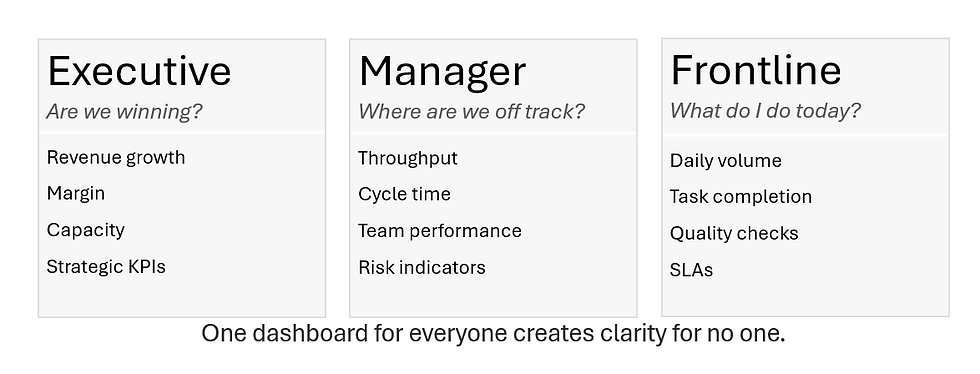
When everyone sees everything, no one owns anything.
Clarity comes from alignment, not volume.
5. Assign true ownership
Every KPI needs a clear owner with authority to act.
Ownership is not about reporting.It is about accountability and follow-through.
When ownership is unclear, performance stalls.When it is clear, action follows.
6. Review, adjust, and evolve
As the business grows, your KPIs should evolve with it.
Metrics that mattered last year may not predict success next quarter.
Strong operators revisit their KPIs regularly and refine them based on what is actually driving outcomes.
Trust the Process. Verify the Outcome.
Documented processes are critical.They create consistency.They reduce variation.They give teams a clear way to execute.
But process alone does not guarantee performance.
You have to confirm that what was designed is actually delivering results.
RevenueCostClient experienceEfficiencyCompliance
This is where KPIs do their real work.
They validate whether the process is working as intended.They expose where it is breaking down.They show you where to adjust before the impact compounds.
Without that feedback loop, even well-designed processes drift.
Workarounds creep in.Handoffs weaken.Performance becomes inconsistent.
This is the difference between having a process and managing one.
Strong operators do both.
They define how work should happen.Then they use KPIs to see how it actually happens.
And when there is a gap, they fix the process. Not just the outcome.
Most companies are not underperforming because they lack effort.They are underperforming because they are not managing how the work actually moves.
You can have a roadmap.You can have a documented process.
But if you are not measuring whether that process is delivering the outcomes you expect, you are still guessing.
KPIs close that gap.
They turn process into performance.They turn activity into results.They turn strategy into something you can actually run.
If your KPIs are not helping you validate, adjust, and improve how work gets done, they are not doing their job.
At BizOptima, we help leadership teams connect process, performance, and outcomes so growth is not left to chance.
Because growth does not come from what you plan.It comes from what you measure, manage, and continuously improve.


Comments