
The Diagnostic Model:Six Elements of Successful Change
- May 4
- 4 min read
Designing for Scale ·Growth Without Guesswork Series
Article 7 · By Colleen Liebson
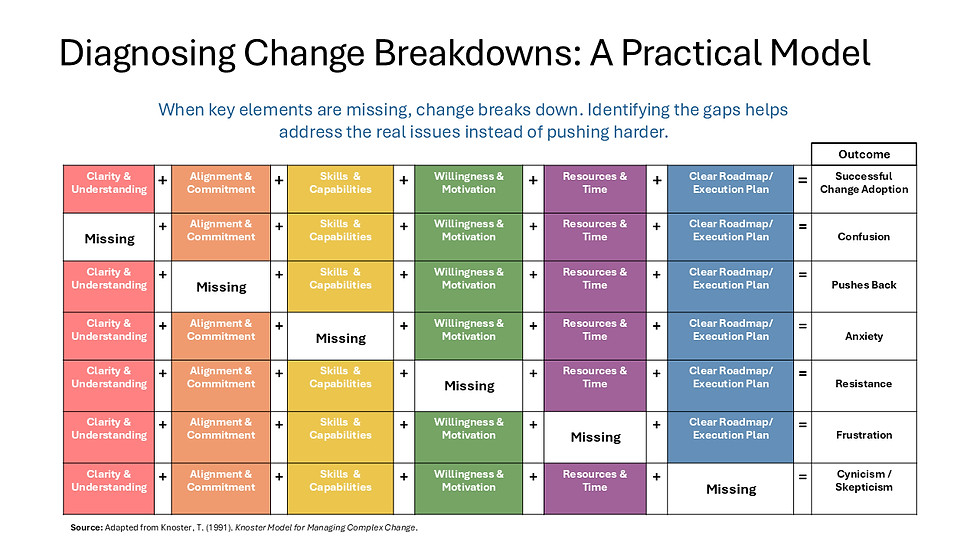
Once you start looking beneath the surface, stalled initiatives stop looking mysterious. They start to look predictable. In almost every case, what seems like resistance, confusion, or poor follow-through can be traced back to a missing element of change.
This is where the Diagnosing Change Breakdowns model comes in.
This model breaks successful change down into six essential elements. When one is missing, it creates a distinct, predictable breakdown in execution and behavior:
Clarity & Understanding – People need to know what’s changing and why it matters. Without this, confusion spreads fast, and execution falters before it begins.
Alignment & Commitment – Leaders and teams must not only agree on priorities but also be willing to champion them. Without alignment, you get pushback, passive resistance, or teams quietly hedging their bets.
Skills & Capabilities – Even the clearest strategy fails if people simply don’t have the skills to deliver. Missing capabilities often show up as repeated errors, rework, or dependence on “hero” employees to fill the gap.
Willingness & Motivation – Change isn’t sustained through compliance—it requires genuine drive. When this is missing, you see low engagement, quiet detachment, or minimal discretionary effort.
Resources & Time – If the team is already maxed out, piling on new initiatives just creates burnout cycles. When capacity isn’t addressed, work moves slower, corners get cut, and resentment builds.
Clear Roadmap / Execution Plan – People need to know how the change will unfold—who’s doing what, when, and how it fits together. Without a clear roadmap, uncertainty takes over, and teams fill the gaps with their own interpretations.
The power of this model is its simplicity: instead of treating symptoms like delays or resistance with more pressure, you can diagnose the missing element and address the root cause directly.
If clarity is missing, the solution is communication and visioning—not another deadline. If alignment is missing, it’s a leadership conversation. If resources are lacking, no amount of motivational speeches will help.
Why This Matters During Scaling (And Why You Can’t Afford to Skip It)
At a glance, this model might look like one more framework to consider in an already packed agenda. But here’s the reality: diagnosing missing change elements isn’t extra work—it’s the work that prevents everything else from stalling.
In a scaling environment, speed and complexity increase simultaneously. Priorities shift faster. Teams are stretched thinner. Dependencies multiply. Under that pressure, small gaps turn into expensive slowdowns.
COOs often underestimate how much time, political capital, and execution power gets wasted reacting to these breakdowns after they happen. The fire drills, the repeated “reset” meetings, the leadership frustration — all of it stems from missing elements that could have been surfaced and solved early.
This isn’t a “nice to have.” It’s a force multiplier. Spending a little time upfront diagnosing gaps saves weeks (and often credibility) down the line.
In high-growth environments, the fastest way to speed up is to remove what’s silently slowing you down.
How to Use the Model in Practice
This model isn’t theoretical. It’s meant to be used quickly, in the real flow of leadership work.
Use it as a diagnostic tool when a project stalls. Ask, “Which element is missing?” instead of defaulting to pressure.
Map key initiatives against the model during planning to anticipate where execution may break down.
Facilitate leadership conversations around gaps openly—this surfaces misalignment before it cascades downstream.
Pair it with pulse checks (surveys, skip-levels, informal feedback) to understand how teams perceive these elements.

If skills are missing, train. If alignment is off, align. If motivation is low, address the “why.” If capacity is thin, adjust priorities. If the roadmap is unclear, fix the plan. Simple diagnostics, targeted action.
Closing Thoughts: Diagnose Before You Drive Harder
When change stalls, the instinct is to push. More pressure. More meetings. More urgency. But scaling doesn’t break because people aren’t trying hard enough—it breaks because something essential is missing, and no amount of hustle can substitute for that.
This model gives you a way to see the friction before it turns into failure. By pausing long enough to diagnose what’s missing—clarity, alignment, skills, motivation, capacity, or roadmap—you’re not slowing things down; you’re preventing wasted cycles, burned-out teams, and credibility hits later.
As a COO or operator, your job isn’t to become a change management expert overnight. These diagnostics may not come naturally—that’s normal. Most COOs are wired for speed, not for spotting subtle human execution gaps. That’s exactly why embedding this discipline into the organization’s leadership culture is critical.
Without intentional support and structure, this practice slips to the bottom of the priority list when growth pressures rise. With it, you create a leadership reflex that accelerates strategy instead of dragging it down.
At BizOptima Insights, we help leadership teams build practical roadmaps, sharpen their change reflexes, and align execution around what really drives growth.
We work alongside COOs and their teams to train leaders, operationalize these diagnostics, and embed them into everyday decision-making—so this doesn’t become another one-time exercise that fades.
If you’re ready to build this capability into your organization, let’s talk.
@ 2026 BizOptima Insights - All Rights Reserved


Comments